

How Much Should You Set Aside for 1099 Taxes?
A client pays you $5,000. Nothing was taken out, so the whole amount lands in your account, and it feels like all of it is yours.
Part of it isn’t.
At a regular job, your employer holds back tax from every paycheck. With 1099 work, nobody does. That part is on you, and if you spend it, you find out at tax time.
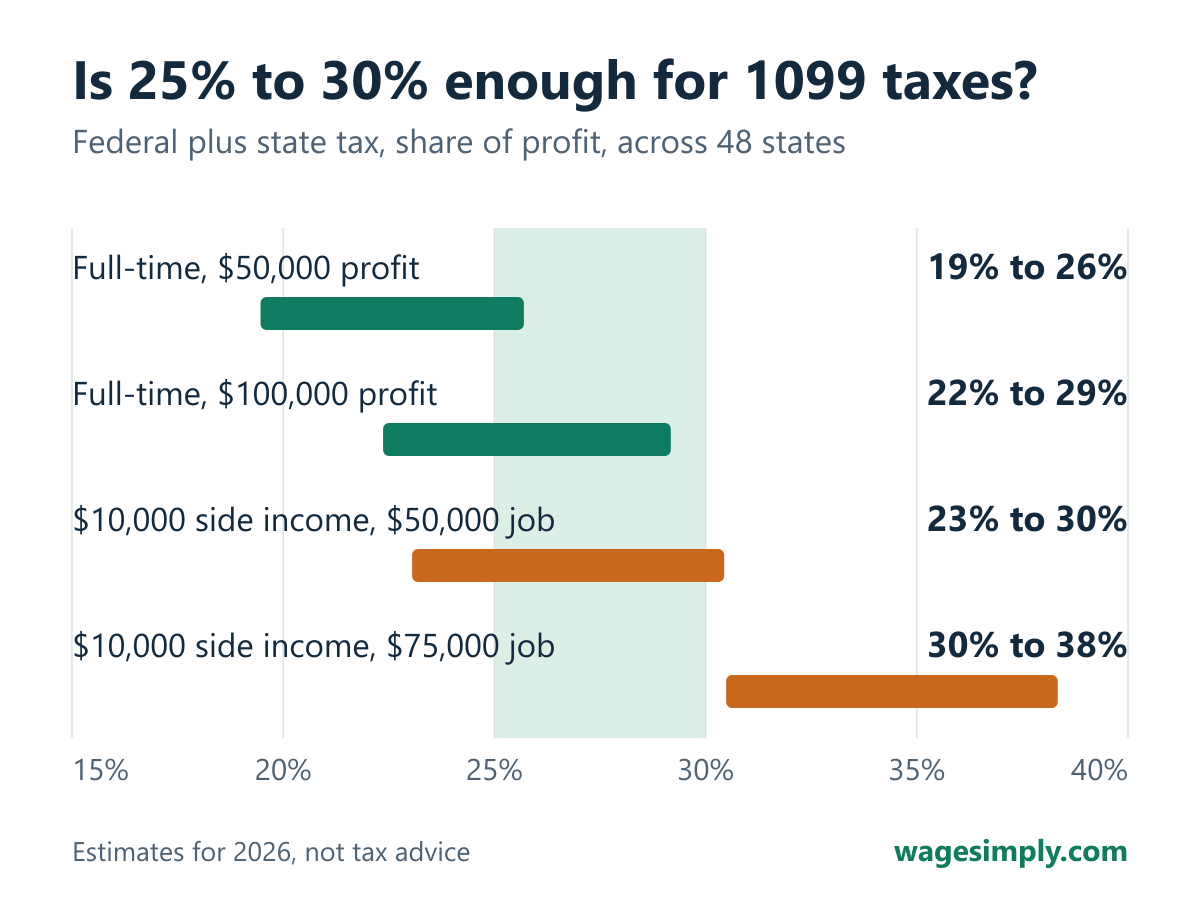
Before you know your costs, setting aside 25% to 30% of that $5,000 means moving $1,250 to $1,500 out of reach. Then the rest really is yours to use. Here’s where those numbers come from.
What one year of 1099 taxes looks like
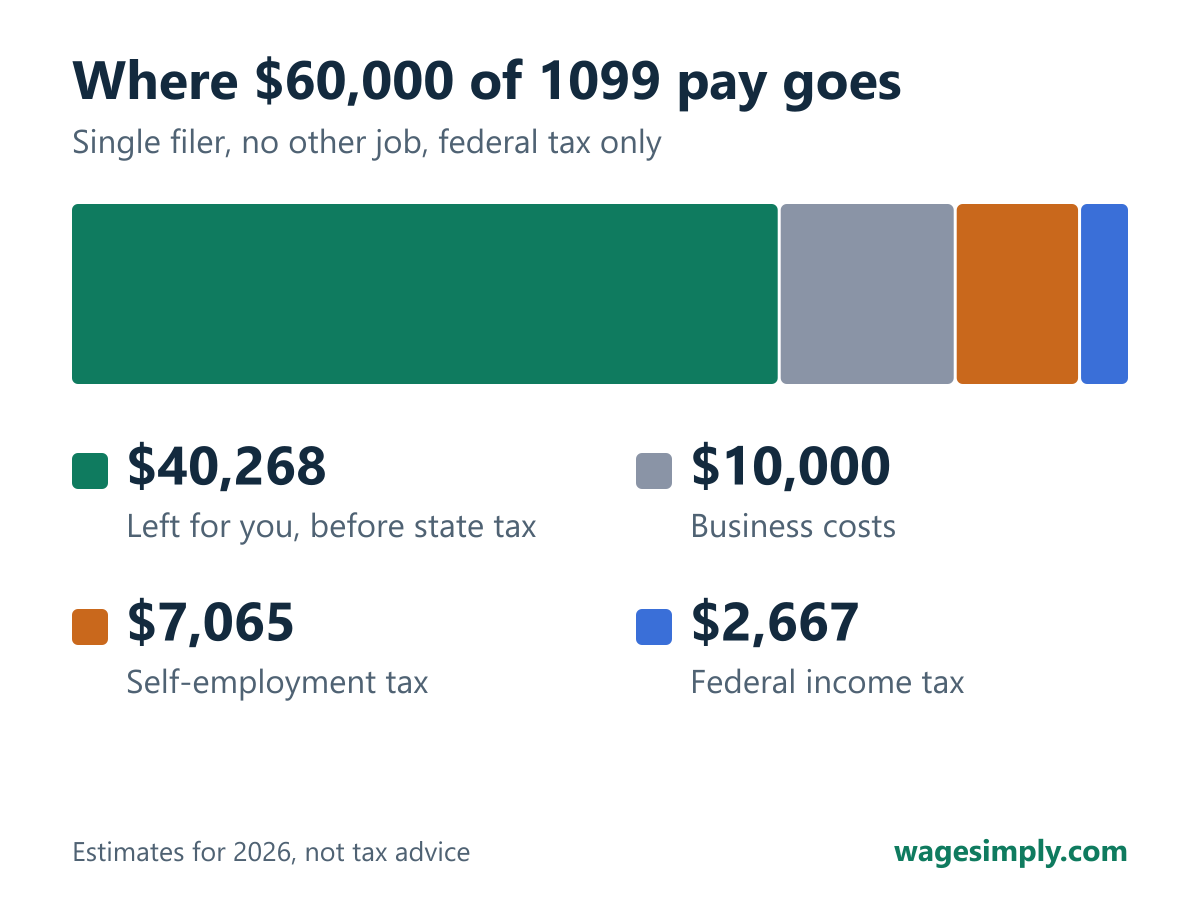
Say that $5,000 arrives every month. That’s $60,000 for the year, and you spend $10,000 on business costs. You’re single, with no other job.
Here’s how the tax adds up:
- Profit: $60,000 minus $10,000 leaves $50,000.
- Self-employment tax: $7,065. This is Social Security and Medicare, charged at 15.3% on 92.35% of your profit. You pay it even if you owe no income tax.
- Federal income tax: $2,667. After half of the self-employment tax, the $16,100 standard deduction and a $6,074 qualified business income (QBI) deduction, $24,294 is taxable.
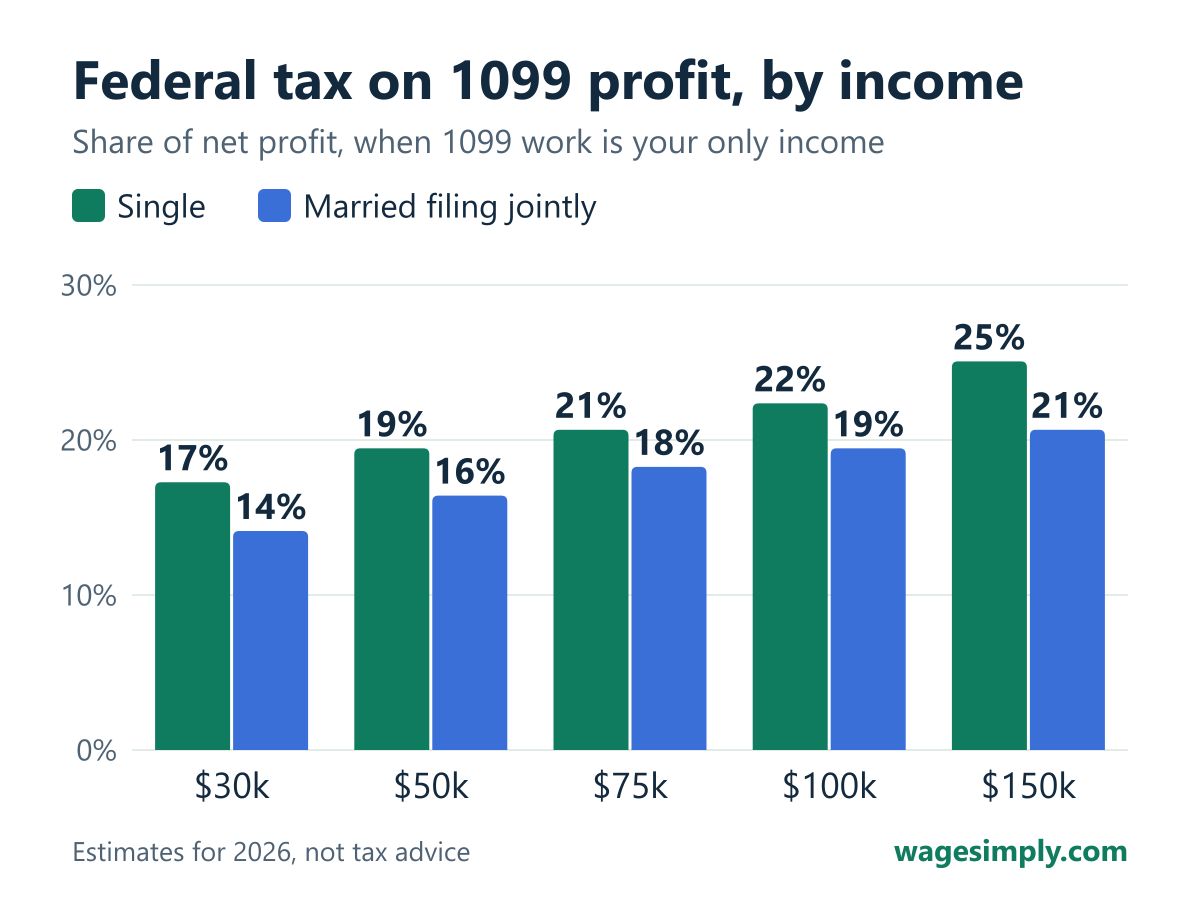
That’s $9,732, or 19% of your profit. If you set nothing aside, it’s a $9,732 bill, before any state tax or penalty.
Set aside 25% of your profit and you’d have $12,500 ready. That covers the federal bill and leaves about $2,768 for state tax. If any is left over, it’s yours.
The more you make, the higher the share
Your state can add a lot
These are combined federal and state shares for a single filer. Check your state’s paycheck page for its rates, or get your exact figure from the 1099 tax calculator.
| State | $50,000 profit | $100,000 profit |
|---|---|---|
| Texas (no state income tax) | 19% | 22% |
| Pennsylvania | 22% | 25% |
| Georgia | 23% | 26% |
| California | 21% | 27% |
| New York | 23% | 27% |
| Illinois | 24% | 27% |
Side income is where 25% falls short
Now say you have a job paying $75,000, and you make $10,000 of profit from side work.
Your job has already used up your standard deduction and the lower tax brackets, so that profit starts at your highest rate. Federal tax on it comes to $3,049, or 30%. Add state tax and it runs from 30% to 38%, depending on where you live.
There’s another way to handle it. You can give your employer a new W-4 asking it to withhold more from your paycheck, and the IRS says this can let you avoid estimated payments.
How to do it
- Open a separate savings account just for taxes. If it’s not in your everyday account, you won’t spend it by accident.
- Move your percentage every time you’re paid. It’s much easier than finding a large amount each quarter.
- Check your number each quarter in the calculator, using your real income and costs.
- Pay the IRS on time. The last 2026 estimated payment is due January 15, 2027. You can pay online, by phone, through the IRS app or by mail with Form 1040-ES.
Setting money aside isn’t the same as paying it. You can owe a penalty for paying too little during the year, even if the money is sitting in savings.
Common questions
Should I use a percentage of my payments or my profit?
Profit is the accurate figure, because tax is based on what’s left after costs. In the example above, $9,732 is 19% of profit but only 16% of the payments. If you don’t know your costs yet, using the percentage on full payments is the cautious choice.
Do I need to make quarterly payments?
Generally yes, if you expect to owe $1,000 or more when you file. The IRS says most people avoid the underpayment penalty if they owe less than $1,000 after withholding and credits, or if they paid at least 90% of this year’s tax or 100% of last year’s, whichever is smaller. Special rules apply to farmers, fishermen and some higher-income taxpayers, so check IRS Publication 505 if that may apply to you.
Do I owe tax if I earned less than $2,000 and got no 1099?
Yes, that income is still taxable. The $2,000 limit only decides whether a client has to send you a 1099-NEC. Self-employment tax generally applies once your net earnings reach $400, which is a net profit of about $433.
Do business costs really lower my tax?
Yes. Costs lower your profit, so they lower both self-employment tax and income tax. Keep your receipts.
What if I set aside too much?
The extra is still your money. Keep it for the next tax bill or move it back after you file.
Figures use 2026 federal rules and assume the standard deduction, the QBI deduction, no tax credits and no other income unless stated. State figures come from the same data as our calculators. The QBI deduction has limits, and not everyone qualifies.
Sources
- IRS: Estimated taxes
- IRS Topic 554: Self-employment tax
- IRS: Self-employment tax (Social Security and Medicare taxes)
- IRS Publication 505: Tax withholding and estimated tax
- IRS Rev. Proc. 2025-32: 2026 brackets and thresholds
General information, not tax advice. Your actual tax depends on your full return.